Showing posts with label UK. Show all posts

Tuesday, 24 December 2013

Queen Speech Bingo 2013

Download and Print your Bingo Cards here!


Hey guys!

I know it's been a very long time since I made an appearance in the blogging world. The last few months have been busy (in a good way) and I have a lot of wonderful posts and photos to share with you. I just need to make time to do it. I'm currently in the UK having a very British Christmas (yay!) and it's a bit of a whirlwind tour visiting loved ones.

Anyway - this was one of my most popular blog posts of the past year so of course I had to do it again for 2013. I'm sneaking it in late this year, but here goes: Queen Speech Bingo 2013!

How to Play Queen Speech Bingo

The full rules are available here but really it's very simple:


How it Works

I use a list of the most common words from previous Queen Christmas speeches, and throw in a few extras (wildcards) to reflect recent events. Extra words for 2013 include George, information, internet, and independence.

Let me know if you decide to play, and of course, who wins!

Friday, 12 April 2013

Five movies about Thatcher's Britain

Much of this week's UK news has been dominated by the news of Margaret Thatcher passing away. As a Brit, and a child of Maggie's Britain, no less, I have been asked by Americans several times this week why she was such a divisive figure for the UK.

I'm not going to talk about that here, at least not directly. Instead, I'm going to celebrate what I think is one of her greatest legacies: Her (perhaps unwitting) contribution to the arts.

Because she was such a divisive figure, and also because she was not popular amongst artists, this led to a vibrant and highly politicized arts and cultural legacy. If when you think of 'British Cinema' you think of Harry Potter, Love Actually, Monty Python, or even the Carry On movies, then I'm about to change that for you.

Here are five brilliant movies about Thatcher's Britain, listed in order of release.
Links are mostly to UK trailers, so please assume they are all NSFW!

1. Educating Rita (1983) Set in Liverpool


Working class girl does good: A scouse hairdresser decides to better herself by enrolling into the Open University. The OU is a respected UK distance-learning institution which was established in the 1970s and was very innovative for its time. The story revolves around her eagerness to move in new social and economic circles. It was a breakout movie for newcomer Julie Walters, aka Molly Weasley from Harry Potter.

2. My Beautiful Laundrette (1985) Set in London


On the surface, the lead characters in this movie also live according to the entrepreneurial values of the deregulated Thatcher era, by running a successful business. The irony is that they are mixed-race, gay, and loosely involved in trafficking drugs. Huge social commentary on politics, race, and relationships. It was nominated for an Oscar but lost out to Woody Allen.

3. Letter to Brezhnev (1985) Set in Liverpool


Two girls, one unemployed and the other working in a chicken factory, meet two Soviet Russian sailors. The unemployed girl decides that life in Soviet Russia would be better than life in 1980s Liverpool. She writes to the communist leader Brezhnev, asking him if she can move to Russia. There's an ironic message here about a poor girl hoping to 'live the dream' in the USSR, but there's also a frightening close up of a girl's hairy armpit, so be warned.

4. The Cook, The Thief, His Wife, Her Lover (1989)


Michael Gambon, aka Dumbledore, plays the Thief in this lavish movie by Peter Greenaway. He represents the 'nouveau riche' of the 1980s: He's wealthy and provides for his wife (Helen Mirren), who wears Jean Paul Gaultier, eats expensive food… and is having an affair with a lowly academic. Very aesthetic, hugely symbolic, and definitely not for the faint-hearted (trust me, it's more disturbing than the hairy armpit).

5. Billy Elliot (2000) Set in Northumberland circa 1984-5


Part of this movie is a sweet tale about a young boy pursuing a dream, but it's set against the backdrop of the 1980s Miners' Strike. Also starring Julie Walters/Molly Weasley. 

I lived in North East England during the 1980s and there is a part of my family that hails from Northumberland: They were a mining family. Seeing a former miner choke up at this movie's depiction of the political/economic unrest brings a gritty strength to Billy Elliot. 

Also see Brassed Off (1996) and the Full Monty (1997) which star Ewen McGregor and Robert Carlyle respectively. Although these two movies are set during the post-Thatcher 1990s, they capture similar themes to Billy Elliot.

Their US trailers are really funny, because they make these movies seem a lot more corny than they really are. They also have the same typically deep blockbuster voice. The US trailer for Brassed Off even describes it as a 'sexy comedy' as if it's Four Weddings and a Funeral. Warning: It's really not. Check them out: Billy Elliot, Brassed Off, Full Monty.

All of these inspired this Mitchell and Webb British underdog movie sketch. If you love British movies and don't understand the rules of cricket, you'll find this hysterical.

Monday, 18 March 2013

Disconnected: The end of an era for the BBC

Today was the last BBC News broadcast from the legendary Television Centre in London.

I've mentioned a couple of times just how much I have loved the BBC's Television Centre (TVC), namely here and here.

In a rarity for this blog, here are some fantastic images taken by a good friend of mine who works (yes, still works) in TVC. He's been doing a beautiful job of capturing the transition of TVC from the nucleus of British broadcasting to, well, a spooky technological relic. He kindly gave me permission to show you some of these photos, but make sure you check out the rest of them here.

TC10 gallery
The Gallery of TC 10 (Studio 10), which used to look like this.
TC7
TC 7 during its last news transmission, only you can't tell, because the studio sign has disappeared.
Don't miss out on his other photos here - they progress from 2006 right up until the last news broadcast today.

You can also watch TVC's last news broadcast here:


I grew up seeing this building on television, and even though I'm on the wrong side of the ocean, it's weird to think that British television will no longer be filmed within these cavernous studios set inside a giant doughnut.

Friday, 15 March 2013

Five characteristics of Britain, illustrated through flowers

The charm of this year's Philadelphia Flower Show (the largest indoor flower show in the world) was the theme: Great Britain. It was fun for me not only to see the gorgeous displays, but also to get an inkling of what the US thinks about my home-turf.

Here were five themes of the flower show that really made me feel at home…

1. Rain

How many times have Americans asked me if it really rains every day in Britain? I've lost count. I always tell them "yes, every day, never a day without rain". Considering that the size of the UK stretches from Maine to North Carolina I'm probably not wrong.

2. The Beatles

Did you notice the Let it Be garden just there? Well it wasn't the only Beatle themed garden. My favorite setting of the whole show is this one just here. Can you guess the two songs?

3. (Childrens') Literature

There were two Alice in Wonderland gardens - this large setting here, and a smaller one with a topiary Cheshire Cat and White Rabbit. I also saw Jane Austen,  Sherlock, and Dracula. Some were better than others, and some relied very heavily on non-plant props. 

4. The Monarchy

From the moment visitors entered the grand hall in the PA Convention Center, they'd see it was a royal floral affair. The crown jewels were spectacular, and the dried flower portraits were stunning. Can you see Her Majesty making a sneaky appearance?

5. Tea

This one was subtle, but it was definitely there. Whether it was a hidden teapot in a bijou apartment deck garden, the Mad Hatter's Tea Party, or a simple cup of tea between innings (that's a cricket thing), my old nation's favorite drink could be found. 

Wednesday, 13 March 2013

"Shame"

In the past week my alma mater has hit the news several times. It's been covered in the local press, national radio, and even on news sites on this side of the pond.

 It didn't make for pleasant reading.

That's disheartening for a proud alumnus because Glasgow University is a fantastic educational institution, with a great culture and campus atmosphere.

Students at Glasgow have since made a protest against sexism, on International Womens' Day, which makes me proud, but also actually a little ashamed.

Just under ten years ago I arrived on campus at Glasgow University for freshers' week, excited about the week and the years ahead of me. Before I'd left home for Glasgow people told me that I would be a 'QM girl'. This apparently meant that I loved 'alternative' music, and that on some level, I was proud to be a woman.

QM stands for Queen Margaret, who is often credited with bringing learning to Scotland. The Queen Margaret Union (QMU) is one of the two student unions on the campus. The other is the Glasgow University Union, although both are equally official and part-funded by the university. The GUU had begun as a male-only institution, so the QMU had started, at the turn of the 20th century, to cater for female students.

To clarify, UK universities don't have sororities (I'm still not entirely sure what a fraternity or sorority is). Instead UK universities have student unions, usually spaces on campus that provide various services to students including advice and support, as well as leisure, cheap food, and drink.

Glasgow is unique in having two unions, a remnant from the days when they were segregated. Although the QMU became co-ed in the 70s, and the GUU in the 80s, both retained distinct characteristics, and students could actively choose one to join. For some, including myself, it was a source of campus identity.

The stereotype of the GUU was rugby, tweed, cheap beer, excellent debating and a hint of chauvinism. The stereotype of the QMU was grunge, goth, lgbt, cheap jack daniels and a historical sense of feminism.

There was an ancient rivalry between the two buildings, sat at opposite sides of the campus. During the freshers' week address representatives from both sides would don colored t-shirts and cheer for their own side. Within a gothic building often said to have been considered as a set for Hogwarts, there was an amazing buzz of excitement not unlike Houses roaring for their Quidditch teams.

During my freshers' week the GUU hit the news for a headline in their daily newsletter, Filth. "No means yes and yes means harder" it said, a phrase that was condemned by rape support groups. I'm not sure it had any effect on my decision to join the QMU, to be honest, because that was going to happen anyway.

The stereotypes of the two unions were well-known. A campus staff-member once told me about a group called the "Freds", who watched Tom and Jerry cartoons (by Fred Quimby) in the GUU during lunchtime, followed by hardcore porn, while feminists known as "The Women's Group" protested outside on the streets.

That happened way before my time on campus, but these feminists were remembered in the QMU's constitution, which recognised continuing  support for "The Women's Group", and even though the group no longer existed, the clause remained just in case it was ever needed again.

After the GUU became co-ed in the 1980s, a men's group known as the 139 was formed. It honored the 139 GUU members who had voted against allowing female members. They were known to have male-only dinners and drinking sessions which were rumored to have elaborate rules. One I heard about was that they'd all stand in silence if a woman entered the room.

I don't have a problem with single-sex groups in principle, as long as their raison d'etre isn't purely to exclude. Oxford University has its notorious Bullingdon Club. St.Andrews University had a male group for a long time, named after a woman, Kate Kennedy (KK). The KK no longer exists though, after male members voted to admit women last year.

Having risen through the ranks of the QMU's board, I once attended a (different) dinner at the GUU, and was seated with some members of the notorious 139. They asked me if I was offended by their 'banter'. I was offended, but I just looked at them blithely, and said "it all just seems a bit homoerotic to me". They laughed.

While the GUU and QMU had had at times a vicious rivalry, that wasn't the case when I was a student. It was a post 9/11 world, the economy was good, but the two unions were both struggling financially and often worked together to achieve goals on campus. I enjoyed the GUU: I ate, drank, danced and socialized there, just not as much as at the QMU.

The unions both had particular cultures which were caricatured by their stereotypes. The GUU has had many female members and board members, though to my knowledge still hasn't had a female president (I'm wrong, see comments below. The GUU has had a handful of female presidents). In my final year I ran for election as QMU President, but lost out to a male friend. Incidentally, since going co-ed, the QMU has had more male presidents than female, although overall it's had far more women leading the Union.

I was disappointed when I read about the sexist comments that the Cambridge students experienced. I admit I don't know exactly what happened beyond what the news reports say, but what strikes me is that incident rings true to a stereotype with which I am familiar.

I was proud to see the protest in response, and the petition. And that's where I feel a bit embarrassed.

You see, I was a proud QMU member and proud female student, but my derision of campus misogyny was never really more than a sense of snobbery. As one friend pointed out to me this week, people who didn't like one union could just join the other, rather than attempting to make positive changes.

I asked another girlfriend and former 'QM girl' what she thought about the sexism accusations, and she replied, "I was smug because I was not one of them…when instead we should have made a stand against it.  In a way our joining the QMU gave us this shield that said 'well obviously I am against sexism, I am in the QMU'. Because others had made a stand in the past, we didn't need to bother because we co-opted their fight through our shared QMU membership."

We were passive feminists. We let boys be boys, maybe expecting that one day their jokes would get tired. I'm sure there wouldn't have been a cultural sea-change had we joined the GUU, but perhaps in an indirect way we perpetuated the GUU's culture.

A recent thread on Reddit asked school bullies why they used to bully. Many of the responses were from people who didn't realize that they were bullying, they thought that they were being funny and didn't realize that others didn't find them funny too.

It took an outsider, a member of neither the GUU or the QMU, a student from Cambridge, another Russell Group University like Glasgow, to point out the jokes are tired and no longer funny.

The incident at Glasgow and the media coverage seems to have resulted in a different kind of debate to the one that sparked the frenzy. I hope that can be a good thing.

Tuesday, 5 March 2013

The bloomin' Phila Flower Show

If you can't guess, the theme of this year's Philadelphia Flower Show is good ol' Great Britain! Of course this Philly-based Brit had to take a look.

I have plenty more photos where these came from… But if you'd rather see these darling buds for real, the show goes on until the end of the week. It's jolly good!

Tuesday, 29 January 2013

In defense of public transport

Fellow expat blogger Selena is a Texan living in England. Recently she wrote a very heartfelt piece about her experiences on public transport. To put it simply, her post was not very complimentary, but it was very funny.

She has been transplanted from the place with the most drive-thru liquor stores in the US (yes, really), to London, which this year is celebrating the 150th birthday of the tube, the oldest subway system in the world. That's a definite culture clash.

In contrast I myself have been transplanted from a place where retirees get free bus rides (and certainly use them) to the land where planners removed sidewalks to fit in parking lots.

I told her I felt I had to defend public transport just a little. So here it is, a Brit's defense of public transport (though I know true Brits write 'defence' and not 'defense' I have to use the American spelling now).

Effort

Public Transport
Selena's first criticism of public transport (namely the London tube) is that it's almost impossible for newbies to navigate. But the London tube map is hailed as one of the great successes of design - a marriage of form and function - beautiful and understandable!


Yes, maybe at first you will end up going around the Circle line the wrong way; discover that some stations are actually quicker to walk between (what's the point of them?); or take three hours longer than expected due to weather, strikes, or engineering works. But overall it works, and the Olympics were testament to that - just ignore the fact that they drafted in thousands of volunteers to show spectators which stations to use.
 
These days it's not hard to plan your journey online, even with sporadic construction or random closures due to pigeons on the line. And when you get really good at the Tube you can have all sorts of fun: You can become expert at games such as Mornington Crescent and this cryptic game. The London Tube inspired subterranean public transport across the world, so it must be okay, right?


Driving
The effort to drive is huge. First you have be examined on how to control a large piece of machinery. You don't sit need to any tests before you hop on a bus. As long as you have correct change and acceptable body odor tolerance, you're fine!

Planning a route to drive is infuriating. Even with Google Maps and Sat Navs you can never accurately predict roadworks, heavy traffic or road closures.

If you take a wrong turn you often have to do a massive detour to get back on track. With public transport you just jump off and get on a different train/bus, but in a car it's actually treacherous: Do you take that U-Bend and cross four lanes of angry traffic, or do you drive an extra 20 miles back the way you came?

In the city you have to learn the patterns of intersection lights, get stuck for hours at multiple red lights, dodge jaywalkers and tourists, and you're expected to know the whole city's randomized system of one-way streets. I swear city planners switch up the one-way system every now and then just for fun.

And then you have to park your car somewhere. This can take hours in certain places, wasting precious gas money and shopping time driving past giant SUVs taking up two spots and shopping carts lazily abandoned everywhere. When you finally end up at the opposite end of the parking lot you feel you may as well have walked anyway.

Storage

When you're traveling by train, plane and underground you really don't want to be laden down with unnecessary shit, so you get really good at traveling light. It becomes a source of pride when you show up for a weekend break with just one half-empty weekend bag, or an overnight function with just a change of knickers and a lipstick in a tiny purse.

Public transport makes you efficient. You keep your Osyter/Octopus/Calypso/Opus/Charlie/Freedom/Smartlink card in your pocket, and everything else on your back.

You gain a sense of freedom by being able to pack so lightly. You know if anyone calls you last minute for a luxury trip to the Bahamas leaving in one hour, you'd be at the airport in time with just your toothbrush, bikini and sun cream, and you wouldn't even have to check in. My rule for travel now is - if I can't lift it, it's not coming with me.

And that's the other thing - all the lifting, carrying and walking is healthy! I saved a fortune on gym memberships when I used public transport. I'd happily walk 45 minutes to work each day. Now I have to drive to the gym and it just feels so wrong and contradictory.

FREAKING PEOPLE EVERYWHERE

Public Transport
Petty people politics is never so apparent as on public transport. It's tough out there, jostling up against all and sundry on the rush hour tube, rubbing your shoulders against other people - who knows where they've been - and touching the same poles and sitting in the same seats. It'd make a hypochondriac's skin crawl.

Plus you have to endure their rudeness. Shoving in front, listening to loud music, folding their newspaper into your field of vision, giving their luggage the last seat on the carriage so you have to stand. There's no such thing as personal space on public transport- how dare they sneeze/text/fart/argue in your vicinity?

If you're having trouble securing a prime seat on public transport there are very detailed and militaristic guides to help you. When I was a kid at youth theater we'd play a game known as 'keeping your seat on the bus'. Basically you make silly faces until nobody wants to sit next to you. Trust me, it works. 

But all of this is part and parcel of living in a world with other people who are just not a cool and considerate as yourself. Plus it gives you the prime opportunity to hone that truly British sport of complaining. If you ever find yourself starting a new job in London, you'll instantly make new friends the moment you walk in the door and say "Oh my gosh, the Central line was just awful this morning, did anyone else have a ghastly time trying to get in? I couldn't get a seat at all and we got stuck for fifteen minutes at Bank and…" Trust me, it works.

Driving

The thing is, driving isn't any better. People speed, honk, tailgate (known in the USA as driving up your ass, as far as I can tell),  blind you with their lights, don't indicate and they always cut in front of you, guaranteed.

Gesturing to rude and inconsiderate road users is usually not that helpful
Drivers are in a hurry, they're rude, and they always think they're a better driver than everyone else. This has been extensively researched and it's true - it's a Lake Wobegone effect manifesting at 80mph on a four lane rat race.

And the worst thing is - all the tutting in the world won't do a darn thing! On a crowded tube, Brits take great pleasure in tutting loudly to display their displeasure at another passenger's actions. It's our favorite form of dissent. In a car this does nothing, and you end up becoming one of those deranged, enraged drivers flipping people off and honking at anything, spreading the blood boiling road rage across the region.

You stomp into work, not with a hilarious and frustrating tale of how crowded your train was, but with a loud tirade full of obscenities about the selfish road moron in front of you with the stupid bumper sticker.

It makes me stressed just thinking about it.

I've told Americans how shocked I am by Pennsylvania drivers and they all say the same thing, "Oh, just wait until you get to New Jersey/New York/California/Maryland/Anywhere, they're terrible at driving!"

And I shudder at the thought. On public transport at least you can sit back, plug in your headphones, eat a questionable prawn sandwich, and zen out all the way to Zone Six…

What side are you on? Which public transport system makes you crazy? And which US state really has the worst driver?

PS, if you've never seen this parody of Going Underground, about the London tube, you're in for a very sweary treat (really NSFW).

Wednesday, 16 January 2013

Glad Notes: What makes a Brit proud to be a Brit?

Marks, Sparks, and Migration: How Brits and British residents feel about the UK


Last week my Marks and Spencer slippers got a lot of loving from my readers, many of whom also received Marks and Spencer's footwear and/or sleepwear during the festive season.

Now there's demonstrable proof that M&S really does have socks appeal. This week a poll by think tank British Future revealed that M&S makes 4% of Brits feel proud to be British.

Though to be fair another UK department store, John Lewis, also allegedly makes 4% of Brits feel proud to be British, and of course these two stores pale behind other institutions that make Brits proud, ranking below the UK National Health Service, Military, and Olympics sportsfolk to name a few.

Pure socks appeal
Incidentally another recent poll, albeit run by a British bread company, claimed that Brits are most proud of their sense of humor and the lush green British countryside. Sturdy y-fronts, cosy slippers and emotive advertising didn't even get a look in (you've seen John Lewis's famous Christmas ads, and Marks and Spencer's salacious food porn, yes?).
On a different note, the British Future poll highlights Brits' unease and concern over the issue of immigration. Brits claim immigration causes the 'most division in British society as a whole today' above inequality, politics and even ethnicity. The poll also indicates Brits' general perception that immigration negatively affects housing, crime, employment and the NHS. The majority of those polled did however believe that immigration had a positive effect on football, fashion, food and entrepreneurship.

Interestingly, although six out of ten Brits wouldn't want to be citizens of another country, the poll suggests that immigrants to the UK are on the whole more positive and more optimistic about Britain and the country's future than natural-born Brits.

The UK coalition government is currently implementing new immigration reforms, with the overall aim of significantly reducing the UK's immigrant population. Regular readers of the Glad Blog will know that I have strong opinions about these latest immigration reforms.

A cross-party Parliamentary group is currently undertaking an inquiry into the new family migration rules, and individuals who have 'direct experience of the new family migration rules' are encouraged to provide written evidence by the deadline of 31st January 2013. I'm eager to see the results of this inquiry so I'll be sure keep you updated.

Finally though, I couldn't find data on the percentage of those born outside the UK that feel pride for M&S and their indoor winter clothing, but I have asked British Future and will report back to you on that too!

Tuesday, 1 January 2013

12 Days of Gladness: August

Hope Solo
August 2012: Hope Solo, part of the Olympics US Womens' Soccer team, just before they earned their gold medals
In August I flew back to the motherland to attend the London Olympics.

I had the strange feeling of being a British foreigner in my own country. But it was a fantastic experience, and especially so rooting for the US Womens' Soccer team in the Gold medal match. I've never felt so proud to be British, American (kind of) and a woman all at once. 

It was an inspiring event. I was particularly inspired by Candice Neethling, who came last in the Women's Mountain Biking event, but I was also inspired by the optimism, excitement and organization that London and the UK exuded during the Games.

Photo geekery: I didn't take my DSLR to London, although the challenge of taking photos of the Games would have been great fun. This was taken on a point and shoot camera.

Sunday, 30 December 2012

12 Days of Gladness: June

June 2012: A huge month for Britain, and a huge month for me! The Queen celebrated a long tenure. The Olympic torch did its tour of the country, and so did I, before I hopped over the pond for good.

This photo was taken in Edinburgh after a Jubilee weekend spent with old friends. It sums up part of my mixed identity: I was born in England, and grew up in Scotland, and now I live in the USA.

The Sigma 80-200m lens is really useful for city photography because you can zoom into rooftop details, or catch little moments far away. I probably should have used spot metering here, as the sky is very washed out (in truth Scottish sky is often totally overcast in white or grey and that poses lighting challenges). 

Here's a bonus photo of the same weekend in Edinburgh. Both Edinburgh and London have this wonderful sense of history and present occupying the same place. You can get lost in winding cobbled streets of tall buildings practically built on top of each other, squeezed in as tight as can be. But the old towns are mixed up with newer builds and shiny store fronts: Beautiful and unusual cities.

I know said I'd only do one per month, but my husband is a fan of this photo, probably because it adheres to the classic rule of thirds, making it aesthetically pleasing to the eye.


Friday, 28 December 2012

12 Days of Gladness: April

April 2012: taken through a car window, but a realistic picture of Britain!
It was tough to choose just one photo to represent April because it was a month of contrasts. I spent the first half of it in London, running around Television Centre/Center working on a consumer news show and living the TV dream. By the time I finished my stint at the BBC I had received word on my visa interview date and could start to plan my move to the USA.

In the second half of the month, I visited friends way up in the Outer Hebrides. They drove me around the Isles of Harris and Lewis while I took snaps through the car windows. I thought this one looked quintessentially British enough to represent a month of coast to coast travel!

As I was born near London and have plenty of family there, it's a city I know very well. I feel very at home whenever I'm there. London is a huge contrast to the silent expanse of the remote Scottish islands, although both regions are steeped in history.

This is not my favorite photo from my trip, these are.

Photo geekery: Sitting in the back of a car and tumbling through the Islands of Scotland was a super fun challenge. I constantly had to adjust the camera settings and snap as quickly as possible before we turned a corner and reached another photo opp. Clouds moved in/out and changed the lighting all the time. Because I was on the move I took photos at a really high shutter speed to cut down on blur.  I upped the saturation in this photo to enhance the red and orange. I also brightened it a bit so you can see right into the abandoned house.

Thursday, 27 December 2012

12 Days of Gladness: March

March 2012: Transitions - what's approaching around the corner?
March 2012 was a crazy month! I left my job to prepare for getting my US visa and for moving abroad, but two days later found myself on a train to London to work at the BBC for a month.

By this point I'd been living and working in the East Coast of Scotland for just over two years, and I had been separated from my husband for that long too. For six years prior to that I had lived in the West End of Glasgow, where I picked up two degrees, a whole bunch of great friends, some hilarious slang, and of course, a lovely American chappy.

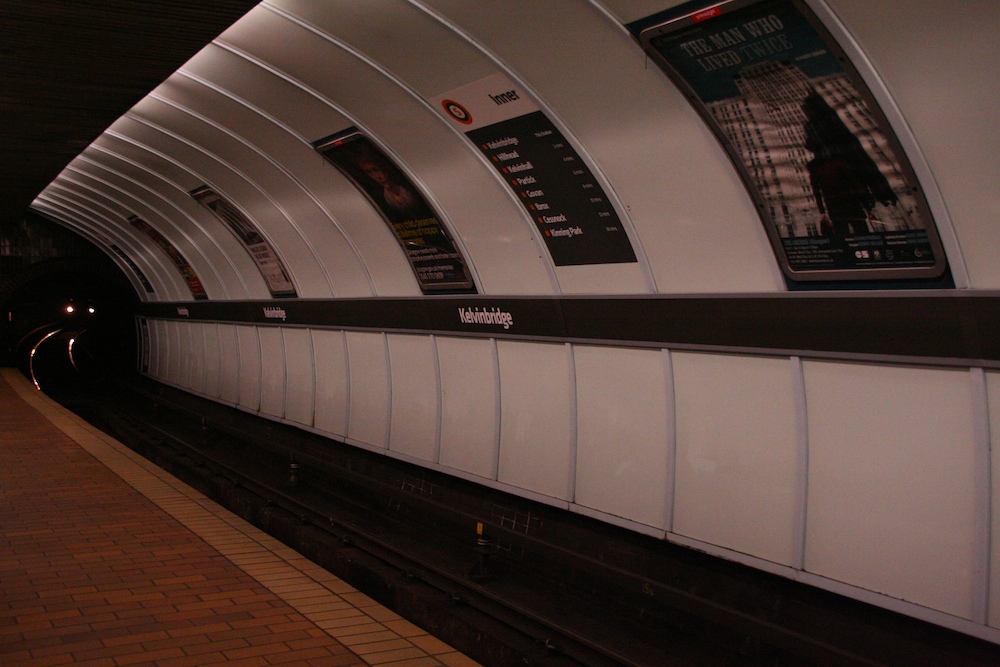
When I moved back to the East Coast of Scotland after graduating I often spent weekends in Glasgow, meeting up with friends and reliving carefree days in my old stomping ground. This is a picture I took of the Glasgow subway, AKA the Clockwork Orange. Glasgow is very proud of its subway system, which comprises just one small ancient circular line. It has its own pub crawl game, the Glasgow subcrawl.

I used to live a short walk from Kelvinbridge and truly miss it.

Glasgow is a fantastic city, just check out this video from the Glasgow School of Art. Glasgow is home to beautiful art deco architecture and has amazing cultural and artistic heritage. It's also brash, a little rough around the edges, and home to some truly interesting individuals.

Now my closest city is Philadelphia, which is similarly artistic yet rough around the edges. Philly also houses beautiful art deco architecture, great arts and culture, and interesting - sometimes brash - individuals! Sounds familiar, doesn't it?

Photo geekery: I took a few photos of the Glasgow subway this day in March. It was a true low-light challenge without a flash, but I think I did pretty well. The highest ISO on the 350D is 1600, and even then it's very grainy. Grainy suits Glasgow quite well, but in other low-light situations grainy pictures can be frustrating.

Friday, 21 December 2012

Queen's Speech Bingo 2012

It's that time of year again…

Download and print your bingo cards here!


Every year of her reign Queen Elizabeth has delivered her Christmas Message, broadcast to Brits in silly paper crowns on Christmas day.  It's our family tradition to watch the speech far more intently than most viewers, in order to clock up points for Queen's Speech Bingo.

We've been doing this for years, and a couple of years ago we started to share this tradition. We hope you'll join in the fun…

How to play

Give at least one bingo card to each player. Ensure all players are topped up with gin and dubonnet (the Queen's favorite tipple), well-stocked with chocolates, and overstuffed with a good turkey dinner. Position all players on the sofa, tune into the Queen’s speech at 3pm GMT and let the sarcasm, fun and arguments commence.

You may play however you like, but here are some tips:
- decide whether you will include words not spoken by the Queen herself.
- decide whether you will add your own wildcards (you must share these with your group before the speech).
- no spurious attempts to find out the speech beforehand (especially to those who work at/have contacts at the BBC).
- any disputes must be settled unanimously (family arguments are another Christmas tradition of course).
- choose your own prize. Our winners get nothing, but your winner could be treated like Royalty for the duration of Boxing Day, or the loser could perform a forfeit.

If you're not in the UK…

BBC World News America should be broadcasting the Queen's speech at 12.20pm EST (17.20 GMT)

Unfortunately, while the UK will get to enjoy Queenie in 3D for the first time ever, those of use over the pond will only get it in old-fashioned style telly. What a shame.

How it's done

We took the Queen's Speeches from 1982-2011, extracted 90 of her most commonly used words, and added in a few wildcards based on events from 2012 and suggestions from friends.
We then plugged these words into a simple bingo card maker.

If you like, you can also see 2011's Queen Speech Bingo page and cards here.

Feel free to share amongst all your friends, or at least to any quirky Angophiles you might know. Please let me know if you decide to play along, and how well you do!

Monday, 27 August 2012

Pros and Air Cons: The US obsession with conditioned air

"too darn hot" - make sure you and your bulldogs are cool and hydrated
So I survived August. I say that because Mr was very intrigued to find out how I'd cope in a month characterized by humidity and heat; when locals take their summer vacations to escape the oppressive weather.

To be fair, I made like a true local and disappeared to the UK for a week. I've already waxed Olympyrical about the Games, but my UK trip also allowed me to catch up with friends and family, almost as if I'd never been away. The trip also allowed me to realize a few more of the subtle differences between US and UK culture.

The week I spent in London was wonderfully sunny. This meant I hardly slept the whole time I was there. Why? I, like many US residents, have become addicted to air conditioning, a comfort that is often elusive in UK accommodation.

Air conditioning was (kind of) invented 110 years ago in the now hipster village of Williamsburg, Brooklyn. I first experienced the ups and downs of the US love affair with conditioned air when I found myself in New York City during a heatwave. The mayor warned people not to go running in Central park, the news was filled with locations of 'chill centers' for the young, elderly and other vulnerable folks without air con, and stories of neighborhoods suffering from power outages or power surges. I visited a lot of museums, not only to enjoy their exhibits but also their frosty cool rooms. I learned the stifling discomfort of waiting on a subway platform, and the chilling relief of stepping into a conditioned subway car.

But when I moved over to the USA back in June, I found it hard to get a decent night of sleep: It was too darn cold.

This all brought to mind the stereotype of the wasteful American: During summer they crank up the air con and wear sweaters inside, and during winter they crank up the heating and lounge around in t-shirts. I wasn't used to it - I enjoyed the heat. I wasn't used to light summer bed sheets and cool indoor breezes. I wanted a heavy duvet (AKA a comforter in US English) to weigh me down and keep me cosy. I insisted on turning down the ceiling fan in our bedroom to the lowest setting.

It was lucky I did.

The very next day I stood up on the bed to reach for something and was totally head-decked. The ceiling fan smacked me right above the ear. Mr had to watch in horror as my body crumpled down onto the bed and started to shake.

I was laughing. Oh, I was in pain! I had a lump on my head for a week. But at least the fan had been going slowly enough not to slice my head clean off. This dumb Brit was so unaccustomed to air con that it literally hit her in the face.

But at some point in the past few months something happened to my internal thermostat. It was so subtle that I barely noticed what was happening: I am now fully addicted to flowing, cool air. I find the bedrooms of England stale and stuffy, the hotel duvets too heavy and warm. I still insist on having the ceiling fans on low settings, mostly out of fear, and I try not to stand on the bed anymore, but I sleep soundly, thankful for these artificially cool summer nights.

Tuesday, 21 August 2012

Watching the London Olympics from the UK Part Two

The London Olympics are over - now what? Can Britain keep up the vibe?
I was in a truly privileged position as a spectator in the London Olympics. I traveled economy class, stayed in a budget hotel, had ordinary tickets. But I attended as both a tourist and a local. I saw things from both sides. I experienced the airports, tube, venues etc as a (newly-minted) foreigner, but really rooted for Team GB to do well. By Team GB, I meant everyone, not just the athletes.

This fellow English-born-ex-Fife-expat(and repat) summed up the logistical experience of the London Olympics really well, good and bad. The volunteers and staff were fantastic. They gave directions, they offered encouragement and lightened moods. They suggested great spots to watch the games, and acted as ambassadors who presented the UK as a friendly and outgoing place full of friendly and outgoing people.

The transport and infrastructure also worked perfectly (for me, at any rate). London felt more vibrant and excited than I've ever felt it. I went to bits of London I'd never been to before. Brits seemed genuinely surprised (in a good way) that things went off without a hitch. Blimey, Britain can scrub up well when lit on the world stage.

The BBC can be proud of its coverage as well - which I can compare first-hand to NBC. The overall choice and the ease with which to access it (even in budget hotel rooms) was not only impressive, but exactly what media outlets should be hoping to achieve with technology available to them. I'm not going to go into comparing budgets here and now though - if anyone else has I'd love to see.

What happens now? Will there be long-lasting positive legacy from the Games? Will it truly rejuvenate the East End? Will this bring a new era of super-serving broadcasting? The tagline for these Olympics was "inspire a generation" and the British government is keen to see Britain's bounce last a while. This hasn't happened in Cameron's case, but it'd be great to see Team GB match its medal haul in four years, and it'd be great to have new and old generations inspired to take up sports, whatever the reason, whether Taekwondo medal hopefuls, or healthy yoga-bugs. But sport success isn't the only inspiration to take from the Olympics. Two different comment pieces in the Guardian cover this topic in different ways, one about the sponsors of the games and another more wry piece about the economy. 
 
What legacy would I like to see? What inspired me most? Amongst all the branding, celebration and glamour of the games, there's a different message to take. The Olympics see more defeat than success - only the successful few take home a 'prize' - but the message of perseverance and inspiration would be a great one to carry through to the next British generation. Seeing all the defeated athletes getting cheered on and encouraged was an amazing reminder, both to keep on living the best I can and with the best mental attitude, but to support others around me doing the same.

My previous employer also has a great article about one particular aspect of the London Olympics that could be a great legacy if recognized and nurtured: the Gamesmakers. Can the UK inspire a new generation of civic activists? It's food for thought.

As we wave goodbye to London 2012 and the UK's moment of glory, can the UK keep up the enthusiasm for civic pride?
Glasgow has the Commonwealth Games in just two years. While in London I already heard about people keen to pick up even tickets, including me - I want lawn bowl tickets. I hope there'll be the same enthusiasm to get involved too.

What do you think?

Monday, 20 August 2012

Watching the London Olympics from the UK Part One

All of this post's photos were taken by myself, as always, and my mum, just not on DSLR or manual settings
The Olympic hangover has lifted, the jetlag has passed, and I'm back to my country of residence, munching on pretzels and savoring the cool air con breeze. I did a little skip and a jump through immigration at both ends: Benefit of having a Green Card is being able to travel through the 'Citizen' line at both ends of my transatlantic travelling.

Watching the Olympics in my new home country was pride-inducing enough, but being there in person was a positively giddy experience. I've never seen Brits so animated with national pride as the "jolly helpful people", AKA the Gamesmakers, or the army of Olympics volunteers. It definitely got the red, white and blue blood cells pumping.

During the infamous UK Olympics tickets lottery, my mum and I hedged our bets on events we reckoned other Brits wouldn't want to go to. Ergo, we got tickets for the Women's Football/Soccer Final, Men's Freestyle Wrestling, and Women's Mountain Biking. I was super-psyched and US husband was super-envious.
Olympic Womens' Soccer Final: Fans, Wembley, Hope Solo, US Victory, record-breaking crowds.
As a Brit, I'm predisposed to prefer to support the underdog. In ordinary circumstances nobody would call Team USA the underdog, but this was going to be a close game against Japan, and I was proud to wave my little stars n' stripes. We were directly behind the goal when Team USA scored their first of two - you can see the ball fly into the net in one of the photos above. In the second half we saw Hope Solo do some of her best work of the whole Games.

A defining moment of the match was beating the world record for audience numbers at a women's soccer game: 80,203 fans and an almost packed out Wembley. 80,203 fans that booed loudly during the announcement that Seb Blatter, President of Fifa, would be handing out the medals to the US, Japanese and Canadian champs. A chap from San Francisco sat behind us was audibly shocked:

San Fran: Oh my God, why is everyone booing?
Glad Mum: They're booing Seb Blatter, head of Fifa. 
San Fran: But why?
Glad Mum: He's not very popular. I called my last Fantasy Football team Weak Blatter Control.
San Fran: Wow, that's obviously something you feel strongly about! I can't believe all these crazy Brits booed.

The next day we had Freestyle Wrestling at the Excel center/centre. This included a rather handy introduction to the sport and the moves to look out for: They knew their audience, and most Brits aren't clued up on the minutiae of Freestyle Wrestling. This was much to the chagrin of my Pennsylvanian husband who was shocked to discover I knew very little about the sport. He was very proud that we thoroughly enjoyed the day though, especially as he missed out on seeing another US gold medal broadcast live. He did, however, get the Women's soccer final live on TV, along with the super-boo.

This is an illustration of what wrestling is all about:
Freestyle Wrestling: None of this looks very comfortable.
Women's Mountain Biking was no less gruelling. I couldn't have walked the track without breaking a sweat. 

We picked this sport because it took place at Hadleigh Farm, in Essex, not far from my birthtown. Once again I got to witness USA grab a medal (bronze), amidst a fun festival atmosphere. Team GB cyclist Annie Last did not live up to her name, and came a respectable 8th. 

 
The biggest cheer, however, was reserved for Candice Neethling of South Africa. She came last. A British audience does like an underdog, after all. But at only 20 years old, she's an inspiration to anyone riding a tough track with the odds stacked against them: Keep on pushing on at whatever you do. You can read Candice Neethling's reflections after her tough Olympic race here.
Gold Medal winner Julie Bresset on the right, and the young Candice Neethling, who came last, on the left.
I don't think we could have had a more enjoyable trio of sporting adventure. It was jolly good fun.

Friday, 17 August 2012

Buy Me Maybe? Differences between UK and USA advertising

The British stereotype is of reserved underwhelm and understatement. Americans are used to directness and hyperbole. These two different cultures result in entirely different advertising styles. British adverts are far more likely to tell you not to buy a product, whereas US commercials are much more like a Carly Rae Jepsen parody on a sugar high: Hey, this is crazy, but buy me maybe?

Because Brits are so reluctant to be direct, British ads have to be creative. Kate Fox writes a funny-coz-it's-true account of TV advertising in the UK:
The humorist George Mikes claimed in 1960 that 'All advertisements - particularly television advertisements - are utterly and hopelessly un-English. They are too outspoken, too definite, too boastful.' … the English should evolve their own style of advertising, recommending, 'Try your luck on Bumpex Fruit Juice. Most people detest it. You may be an exception.'
Kate Fox points out that 30 years later this advert actually happened in the UK: I hate Marmite. 

I love Marmite, and also loved this advertising campaign. It was a talking point - do you love or hate Marmite - which is exactly what an advertising company hopes to achieve!

I saw a similar billboard on the London Underground during my trip to the Olympics last week. It was British Airways urging people not to fly: Don't Fly, they said, stay at home and support Team GB. It was another perfect example of Brits using their indirectness, their awkwardness with pushy boasting and brash marketing, to create a talking point. Of course it wasn't altruism on BA's part. I reckon most folks flying to escape the Olympics may have opted for a budget airline, not BA. So rather than killing their own business, BA probably affected their competitors' business, if at all.

Incidentally, the article I linked stated that BA predicted they'd get a lot of business from expats travelling back to London. Sorry BA, I travelled with someone else, but your adverts were better.

BA were an official Olympic sponsor. I know this because their billboards peppered the London tube, along with others from other official sponsors. I had read and heard endless criticism of the commercialization of the Games, which limited choice in Olympic park. I didn't visit Olympic Park, and while I can't disagree, I was struck by something interesting at the other venues I did visit: There was very little advertising at all.

I checked back on footage from previous Olympics (okay, Barcelona '92 and Salt Lake City '02) as London was the first I'd been to, and it wasn't an anomaly. It was, I have to say, nice to wander around the venues and enjoy the sports without constantly being reminded who had helped pay for them. Outside of the arenas, and mostly in the tube stations, the billboards were witty and fun and made me feel back at home - including Marks and Spencer saying "On your Marks for Autumn". Oh M & S, bastion of British sensibilities and sensible underwear.

USA advertising is far more in-yer-face to appeal to that direct and hyperbolic US culture. I've written about it before: American ads pretty much all say "you need this product. Go buy it!" And the majority of commercials seem to be for drugs, poptarts, erectile dysfunction, and diabetes. It's a disconcerting combination of messages to receive during a short ad break.

By 'drugs' I don't mean anything illicit, obviously, but I don't mean over the counter stuff either. I mean prescription medication. "Ask your doctor for XYZ" - it's noticeable to Brits purely because of the different natures of the UK and US healthcare systems. And then there's diabetes.

This map states that prevalence of diabetes in the USA is over 10%, while in the UK it's almost 7%. But I'd love to know what percentage of US commercials relate to diabetes products.

My absolute favorite US commercial right now is for something called Accu-chek Nano. This jingle is the summer pop hit of 2012. You thought it was Call Me Maybe? Nope, you are far off the mark. When I first saw it, I thought it was for a mobile phone for girls. It's not. It's a blood checker for those with diabetes.


This jingle is something else entirely. How a commercial for a diabetes product can be so un-ironically saccharine, I don't know, but it's oh so catchy and moreish. You've listened to it twice already now haven't you? You're resisting the urge to get up and dance. The only thing it's comparable to is the equally girly I love Horses advert that used to hit British screens every New Year:


 I'm not the only one who has noticed this amazing jingle. And, in a twist of the strange, it was even used as the soundtrack for a flash mob at the American Association of Diabetes Educators conference.

They really are trying to cash in on the whole Call Me Maybe vibe to attract a target audience. And that's okay by me. If anyone could actually do an Accu-chek Jepsen jingle remix, I'll send them a whole bunch of candy (irony intended).

Once every year the American population tunes in to the Superbowl, not to watch the sport, but to watch the heralded Superbowl commercials, and to see commercials done properly. Why advertisers can't do that all year round I don't know, and I haven't even gotten round to mentioning Jos. A Bank yet … Put simply, Jos. A Bank is American directness at its finest, and this Brit finds it hilarious.

Have you secretly danced to the Accu-chek Nano jingle? What's your favorite/least favorite commercial? Do you like Marmite? Have you ever actually bought a suit from Jos. A Bank, and if so, what came free?